Most companies do not have a growth problem. They have a systems problem that shows up, on the dashboard, as a growth problem.
That distinction sounds like wordplay. It is not. It is the difference between spending the next two quarters fixing the wrong thing and fixing the right one. When growth slows, the instinct is to push harder on growth: more ad spend, more channels, a bigger sales push. Sometimes that works. Usually it does not, because the slowdown was never about effort. It was about a constraint sitting one level below the number everyone is staring at.
Key takeaways
Slowing growth is almost always a symptom. The cause is a constraint somewhere in the system.
A growth system has stages: acquisition, activation, retention, referral. Growth is gated by the weakest one, not the average.
Pushing harder on a symptom spends more money for the same result. Fixing the constraint unlocks the spend you already have.
To find the constraint, measure conversion between stages and look for the biggest drop against a healthy benchmark.
The symptom and the system
Think about how a doctor works. You walk in with a headache. A bad doctor gives you a painkiller and sends you home. A good one asks what is causing the headache, because the headache is the symptom, not the disease. Treat only the symptom and it comes back, every time, often worse.
Growth numbers are the headache. Revenue flattening, CAC creeping up, conversion sliding. These are real and they hurt, but they are signals, not the problem itself. Somewhere underneath, a system that is supposed to turn inputs into growth has a part that is not doing its job. The number on the dashboard is just where the pain surfaces.
The job is to stop treating the symptom and go find the broken part.
Growth is a system, not a number
Here is the reframe that makes the broken part findable.
Growth is not one thing. It is a chain of stages, and each stage hands off to the next. A customer gets acquired, then activated into real usage, then retained over time, then ideally refers someone else. Inputs go in one end, growth comes out the other, and every stage has a conversion rate.
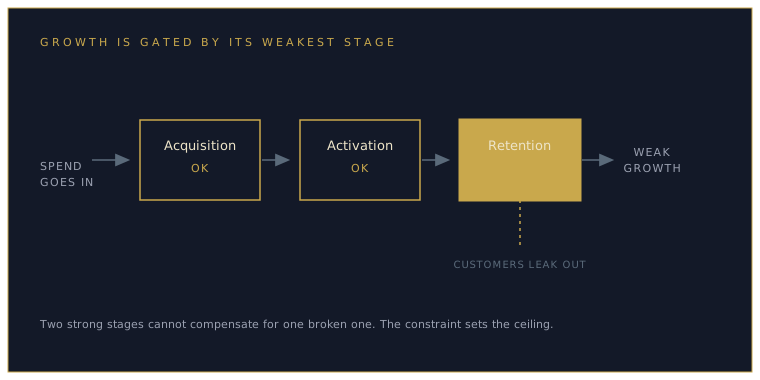
The critical property of any chain like this is that it is gated by its weakest link, not its average. You can have brilliant acquisition, slick activation, and strong referral, and if retention is broken, the whole system underperforms. The constraint sets the ceiling. Everything upstream of it just piles up against the wall.
This is why "spend more on marketing" so often fails. Marketing is acquisition, the front of the chain. If your real constraint is retention, more acquisition just pushes more customers into a system that loses them anyway. You feel busier. You spend more. The output barely moves.
Growth is gated by the weakest stage. Pouring more into the top does nothing if the leak is further down.
The leaky bucket
The clearest version of this is the leaky bucket, and almost every D2C brand I work with has lived it.
Picture a bucket with a hole in the side. You want more water in it, so you turn up the tap. Water goes in faster, and for a moment the level rises. But the hole is still there, so you settle at a slightly higher level while wasting most of the water you are pouring. The honest fix is not a bigger tap. It is patching the hole.
In D2C terms, the tap is acquisition spend and the hole is a weak repeat rate. At Indian D2C customer acquisition costs of roughly 1,800 to 2,500 per customer, a repeat rate below 25 percent means most of that spend evaporates after the first order. Founders feel the symptom as "we need cheaper CAC" and turn the tap harder. The actual problem is the hole: there is no reason for the customer to come back. Patch that, and the same acquisition spend suddenly compounds, because each new customer adds to a base instead of replacing one that leaked out.
I saw this directly at SleepyCat. A mattress is a long-replenishment product, so the system had a structural hole: people simply did not need to buy again for years. No amount of acquisition fixed that, because acquisition was not the constraint. The fix was systemic. Build adjacent products, pillows, toppers, bedding, that gave the same customer a natural reason to return. That is a systems change, not a marketing campaign.
How to find the real constraint
You do not fix this with intuition. You fix it by making the system visible, then measuring it.
First, draw your growth as stages. For most consumer businesses that is acquisition, activation, retention, and referral. Be specific to your model. A subscription business and a one-off-purchase business have very different activation and retention stages.
Second, measure the conversion between each stage. What percentage of acquired users activate? Of activated users, how many are retained at 30, 60, 90 days? Of retained users, how many refer? You are looking for rates, not totals, because totals hide the leak.
Third, compare each rate to a healthy benchmark for your category, not to last month. The constraint is the stage with the biggest gap below where it should be. That gap, not the loudest metric, is where your next quarter of effort goes.
And then the discipline that is harder than it sounds: fix that one stage before touching anything else. The temptation is to improve everything at once. But if the system is gated by one constraint, improving the others changes nothing in the output and burns your team's time. One constraint at a time. Move it, watch the whole system respond, then find the new constraint, because there is always a new one.
Why this matters more than it sounds
When you internalise that growth is a systems problem, two things change.
You stop overreacting to the dashboard. A scary number becomes a starting question, "which part of the system is this telling me about," rather than a fire drill.
And you stop wasting money. Most growth budgets are spent pushing harder on stages that were never the constraint. Find the real one and you often unlock more growth from the spend you already have than from any increase.
The companies that grow steadily are rarely the ones working hardest on growth. They are the ones who understood, earlier than everyone else, that growth is an output. Fix the system, and the number takes care of itself.
Frequently asked questions
What does it mean that growth is a systems problem?
It means slowing growth is usually a symptom, not the disease. The real cause is a constraint somewhere in the system that turns new customers, traffic, or spend into output. Fix the constraint and growth returns. Push harder on the symptom and you just spend more for the same result.
How do I find the real growth constraint?
Map your growth as a system of stages: acquisition, activation, retention, and referral. Measure conversion between each stage. The constraint is the stage where the biggest drop happens relative to a healthy benchmark. Fix that one stage before touching anything else.
Why does spending more on marketing stop working?
Because acquisition is rarely the constraint. If customers leak out after the first purchase, more acquisition just pours water into a leaking bucket faster. You feel busy and spend more, but the base does not compound, so growth flattens.
Isn't this just a funnel?
A funnel is part of it, but a funnel usually stops at the purchase. A growth system keeps going through retention and referral, which is exactly where most real constraints sit. Thinking in systems rather than funnels is what stops you from optimising only the top.
Piyush Wadhwa is a product and growth leader who has scaled platforms from 0.2M to over 1.3M users across fintech and D2C, including as Head of Product at SleepyCat. He advises consumer and D2C founders on finding and fixing the real constraints in their growth systems, and is the author of "Overthinking Is Not a Superpower."