AI tools are giving everyone more leverage. That part is real and it is not slowing down. A solo founder can now produce what used to need a small team. The question that actually matters is not who has access to these tools, because soon that will be everyone. It is who can use them without letting them flatten their judgment.
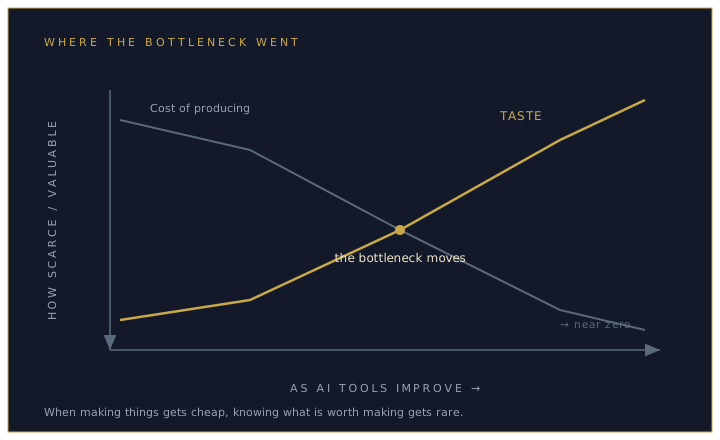
Because here is the thing nobody says clearly enough. When production becomes cheap, taste becomes the scarce thing. The bottleneck moves. It used to be "can we make this." Now it is "should we, and is this version actually good." That second question is the whole game, and AI cannot answer it for you.
Key takeaways
AI lowers the cost of producing things to almost zero. That does not make output more valuable, it makes it more common.
When everyone can produce competent work, the scarce skill becomes taste: knowing what is worth making and what to reject.
Use AI to expand your options, not to make your final decisions. The judgment of what is good has to stay yours.
The risk is not that AI is bad. The risk is that the AI default is good enough to stop you from reaching for better.
The bottleneck moved
For most of the history of building things, production was the constraint. Writing the code, designing the screens, drafting the copy, all of it took real time and skill, and that scarcity is what made good work valuable. If you could produce a clean landing page, that ability was worth something because not everyone could.
AI quietly removed that constraint. A competent landing page, a working prototype, a passable first draft, these are now close to free. And when something becomes free, it stops being the scarce thing. The scarcity moves somewhere else.
It moved to judgment. When anyone can generate ten versions of a homepage in a minute, the value is no longer in generating them. It is in knowing which one is actually good, and being willing to throw out the other nine. That is taste, and it is suddenly the rarest input in the building process.
As the cost of production falls, the constraint shifts from making things to judging them. Taste becomes the bottleneck.
What taste actually is
Taste sounds like a soft word, so let me make it concrete, because it is not vague at all.
Taste is two things working together. First, the ability to tell good from merely competent, which are very different and easy to confuse. Second, the conviction to choose the good one even when the competent one is right there, finished, and would do.
In product work this shows up everywhere. It is knowing which feature actually matters to the user versus which one just looks good on a roadmap. It is knowing which detail to obsess over and which to let go. It is, more than anything, knowing what to leave out, because most of taste is subtraction.
None of that comes from a tool. It comes from exposure, from feedback, from having shipped things and watched them succeed or fail, and from caring enough about the difference to keep refining your eye. AI can hand you a thousand options. It cannot tell you that nine hundred and ninety of them are forgettable, because it does not care, and caring is where taste lives.
The trap is "good enough"
Here is the failure mode I watch happen in real time.
AI output is rarely bad. That is exactly the problem. It is usually fine. Competent. Clean. Good enough that there is no obvious reason to reject it, and just generic enough that it could have come from anyone. And because it is good enough, it quietly lowers your standard for what ships.
You ask for a tagline, you get something serviceable, and the small voice that would have said "this isn't quite it" goes quiet, because arguing with a perfectly fine output feels like overthinking. Multiply that across every decision in a product, every screen, every line of copy, every flow, and you end up with something that is competent in every part and distinctive in none. Death by good enough.
The brands and products that stand out are never the ones that accepted the default. They are the ones where someone looked at the fine version and said no, not yet, and pushed for the version that was actually good. AI makes that push easier to skip. That is the real risk, not that the tool is bad, but that it is just good enough to stop you reaching further.
How to build with AI and keep your taste
The answer is not to avoid the tools. That is a losing position, and the leverage is genuinely worth having. The answer is to be deliberate about which part of the work you hand over.
Hand over production. Let AI draft, vary, prototype, and accelerate. This is what it is brilliant at, and refusing the speed is just pride.
Keep judgment. The decision of what is good, what ships, and what gets cut stays with you. Never outsource the final call to the thing that does not care about the outcome.
A few habits make this real. Use AI to widen your options before you narrow them. Ask for ten versions, not one, then judge hard, because the value was never in the generating, it is in the choosing. Always know what good looks like before you prompt, so you are measuring the output against your own bar rather than letting the output set the bar for you. And keep building your taste the slow way, through exposure to genuinely great work, through real feedback, through shipping and watching what happens. The tools will keep getting better. Your taste is the part that stays yours.
The leverage is here and it is not going away. Everyone will have it. The thing that will separate the work that matters from the flood of work that is merely fine is the same thing it always was. Knowing what is worth making, and having the judgment to insist on it.
Frequently asked questions
Will AI tools make taste less important?
The opposite. When AI makes production nearly free, everyone can make a lot of competent output. The scarce skill becomes knowing what is worth making and what to reject. That is taste, and it gets more valuable, not less, as the cost of producing drops.
How do I use AI without my work becoming generic?
Use AI to expand options, not to make the final call. Let it draft, vary, and accelerate. Keep the decision of what is good, what ships, and what gets cut for yourself. Generic work comes from accepting the AI default. Distinctive work comes from using AI to get to more options and then judging hard.
What is taste in the context of building products?
Taste is the judgment to tell good from merely competent, and the conviction to choose accordingly. In products it shows up as knowing which features matter, which details to obsess over, and what to leave out. It is built from exposure, feedback, and caring about the difference.
Isn't this just resisting AI?
No. Resisting AI means refusing the leverage, which is a mistake. This is about directing it: handing AI the production work it is great at while keeping the judgment it cannot do. You use the tool fully and still own the outcome.
Piyush Wadhwa is a product and growth leader who has scaled platforms from 0.2M to over 1.3M users across fintech and D2C, including as Head of Product at SleepyCat. He advises consumer and D2C founders on building with AI while keeping their product judgment sharp, and is the author of "Overthinking Is Not a Superpower."